
Security · Compliance
Compliance vs. Security: Why a Clean Audit Does Not Make You Secure
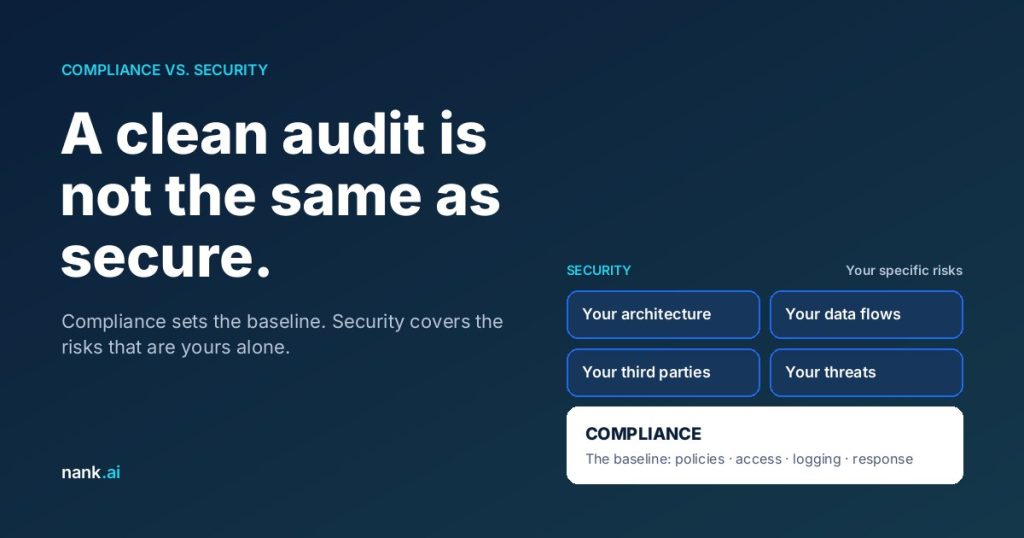
A SOC 2 report or an ISO 27001 certificate proves you meet a standard. It does not prove you are safe from the risks your own business faces. Here is where the line sits, and how you close the gap.
TL;DR
Compliance does not mean secure. A framework gives you a baseline of controls that every firm should have. Security means you find and fix the risks that come from your own systems, data and business. You need both, and the second one is the part an audit cannot do for you.
Sources: IBM Cost of a Data Breach Report 2025 · Target CEO statement, January 2014 · HHS Office for Civil Rights
What compliance gives you
Compliance is not the problem. It does real work, and you should value it.
A framework such as SOC 2, ISO 27001 or the HIPAA Security Rule sets a baseline. It makes sure the basics exist. You write security policies. You control who has access to what. You log what happens on key systems. You have a plan for when something goes wrong. You train your staff, vet your vendors and back up your data.
None of that is trivial. Many breaches still start with a gap in these basics, such as a shared admin password or an account nobody removed. A firm that meets a framework has closed a lot of those doors.
Compliance also builds trust. Your buyers cannot audit you themselves. A SOC 2 report or an ISO 27001 certificate lets them rely on an independent party who checked your controls. That is why so many sales cycles now ask for one before a contract gets signed.
A framework speaks to every firm, not yours
Here is the catch. A framework has to work for a ten-person SaaS startup, a hospital and a bank. So it describes outcomes in general terms. It asks whether you control access. It does not know which of your systems matter most, or how an attacker would move through them.
The framework does not know your architecture. It does not know where your data flows, which third parties touch it, or which feature in your product is easiest to abuse. Those facts are yours alone. A control set written for everyone cannot cover them for you.
Do we meet the standard?
A shared baseline that every firm should have.
Are we protected against our real risks?
The work that only you can scope.
Where compliance stops
Think of a building that passes its fire inspection. Signs mark the exits, the alarms work and the sprinklers are in place. That inspection says nothing about whether a thief can get through the back door. Both matter. They are different questions.
Compliance answers one question: do you meet the standard? Security answers another: are you protected against the risks you face? An audit can say yes to the first while the second stays open.
Why an audit can pass while a risk stays open
Three things about how audits work create the gap.
- You set the scope. A SOC 2 report covers the system you describe to the auditor. An ISO 27001 certificate covers the scope you define. A risk that sits outside that boundary never gets tested.
- Auditors test the controls you designed. They check that a control exists and works as written. They do not redesign your security program or hunt for attack paths. That is what a SOC 2 audit is built to do, and it is a fair limit.
- Audits sample and look back. An auditor checks a sample of evidence across a period or at a point in time. Your systems keep changing after the auditor signs the report. A new feature, a new vendor or a new cloud account can open a risk the next day.
The case everyone in security remembers
In late 2013, attackers stole data on about 40 million payment cards from Target. The retailer had passed its payment card industry assessment about two months before. Its chief executive said so in public.
“Target was certified as meeting the standard for the payment card industry in September 2013. Nonetheless, we suffered a data breach.”
Gregg SteinhafelThen chair and CEO of Target, quoted in TechNewsWorld, January 2014
The standard was not useless. It just was not built to see every path into that network. That is the gap this article is about.
The frameworks tell you this themselves
Here is the part most “compliance vs. security” articles skip. The major frameworks do not claim that their control lists make you secure. Each one tells you to assess your own risks and act on what you find.
| Framework | Where it asks for a risk assessment | What it expects from you |
|---|---|---|
| SOC 2 | Trust Services Criteria CC3.2 | You identify risks to your objectives across the firm and analyze them to decide how to manage them. |
| ISO 27001:2022 | Clauses 6.1.2, 6.1.3 and 8.2 | You run a defined risk assessment, choose controls to treat the risks, and repeat it at planned intervals. |
| HIPAA Security Rule | 45 CFR 164.308(a)(1)(ii)(A) and (B) | You run an accurate and thorough risk analysis, then reduce risks to a reasonable and appropriate level. |
Sources: AICPA Trust Services Criteria, ISO/IEC 27001:2022, and the HIPAA Security Rule as published by HHS.
So the baseline and the risk work are not two separate things. The risk assessment is the bridge between them. It is the clause that turns a generic control list into a program that fits your firm.
The trouble is how teams treat that clause. Many fill in a template, rate twenty generic risks as medium and file it until next year’s audit. The auditor sees a document that exists, so the control passes. The real risks in the real systems never get named.
Regulators have noticed
In the United States, the HHS Office for Civil Rights launched a Risk Analysis Initiative in October 2024. It targets one failure: health care firms that never did an accurate and thorough risk analysis. The office has used it to bring a run of enforcement actions and settlements.
Its message is plain. You cannot protect health data if you do not know where it lives and what threatens it. The same logic holds for any firm, under any framework. If you want a method for this work, see our guides to the ISO 27001 risk assessment and the HIPAA risk analysis.
How you close the gap
Closing the gap does not mean throwing out your framework. It means you do the risk work in full, and let it drive your controls. These are the steps that do the most.
Map your systems and data
List the systems that hold or move sensitive data. Draw how data flows between them, your users and your vendors. You cannot assess what you have not mapped.
Run a threat and risk assessment
Ask who would attack you, what they would want and how they would get it. Rate each risk by likelihood and impact on your business, not on a template.
Test your defenses
A penetration test shows what an attacker can do, not what your policy says should happen. Test the apps and systems your buyers rely on.
Assess your third parties
Your vendors and their tools touch your data. Rate them by the access they hold, and check the ones that matter most in depth.
Monitor all the time
Watch for changes and alerts between audits. New features, new cloud accounts and new staff all change your risk.
Feed findings back into controls
Every real risk should end in a decision and an owner. Add or change controls to treat it, then track it on your risk register.
Where penetration testing fits
A penetration test is the most direct way to see past the checklist. A tester tries to break in the way an attacker would. They find the flaws a control review cannot, such as a broken authorization check in your API or a misconfigured cloud storage bucket. Our guide to penetration testing methodology covers how a good test runs.
Some frameworks and many buyers now ask for a recent test. Treat that request as the floor. Scope the test around the systems that carry your real risk, not the ones that are easiest to test.
What trips people up
Scoping to pass. Teams shrink the audit scope or the test scope to reduce effort and findings. The report looks clean, and buyers trust it. But every system left out is a system nobody checked. Scope by risk first, then decide what the audit covers.
One program, not two
The best firms do not run compliance and security as rival projects. They run one program. The risk assessment sets the priorities. The controls treat the risks. The framework gives the structure, and the audit confirms the controls work.
That order matters. When you start from the checklist, you build what the auditor will test. When you start from your risks, you build what protects your business, and the audit evidence follows. You still pass. You also have a program that holds up when something goes wrong.
This approach also costs less over time. One set of controls, tied to real risks, can serve SOC 2, ISO 27001 and HIPAA at once. You stop paying to maintain controls that protect nothing, and you put that effort where an attacker would look.
What good looks like
You can name your top five risks without opening a document. Each one has an owner, a treatment and a date. Your last penetration test covered the systems those risks sit in. Your audit scope matches the system your buyers use.
Frequently asked questions
What is the difference between compliance and security?
Compliance means you meet the requirements of a standard or law, such as SOC 2, ISO 27001 or HIPAA. Security means you can withstand the threats your firm faces. Compliance sets a baseline. Security covers the risks that come from your own systems, data and business.
Does a SOC 2 report mean a company is secure?
No. A SOC 2 report says an independent CPA firm tested the controls you described, within the scope you set. The firm found they met the Trust Services Criteria. It is strong evidence of good practice. It does not prove that no risk exists outside that scope or after the report date.
Can you be compliant and still get breached?
Yes. Target had passed its payment card industry assessment in September 2013 and attackers got in about two months later. Audits test a baseline of controls by sampling, at a point in time or over a set period. Attackers look for the paths that fall outside that.
Is compliance still worth it if it does not make you secure?
Yes. Compliance closes many common gaps, gives you a structure for your program and earns the trust of buyers and regulators. It is the floor you build on. The mistake is to treat it as the finish line.
How do you go beyond compliance?
Run a real threat and risk assessment on your own systems and data flows. Test your defenses with penetration testing. Assess your key vendors. Monitor between audits. Then feed what you find back into your controls, so the framework reflects your real risks.
Do SOC 2, ISO 27001 and HIPAA require a risk assessment?
Yes. SOC 2 asks for it under criterion CC3.2. ISO 27001 requires it in Clauses 6.1.2 and 8.2. The HIPAA Security Rule requires a risk analysis under 45 CFR 164.308(a)(1)(ii)(A). The risk assessment is where each framework hands the job back to you.
Key takeaways
- Compliance and security answer different questions. Both matter.
- A framework sets a baseline of controls written for every firm, not yours.
- Audits test the scope you set and the controls you designed, by sampling.
- SOC 2, ISO 27001 and HIPAA all require you to assess your own risks.
- A template risk assessment passes the audit but leaves real risks unnamed.
- Map your data, assess threats, test your defenses and monitor between audits.
- Run one program: let risks drive the controls, and let the audit confirm them.
Find the risks your audit does not cover
We run threat and risk assessments and penetration tests that start from your systems and your data. Then we fold the results into the SOC 2, ISO 27001 or HIPAA program you already have.